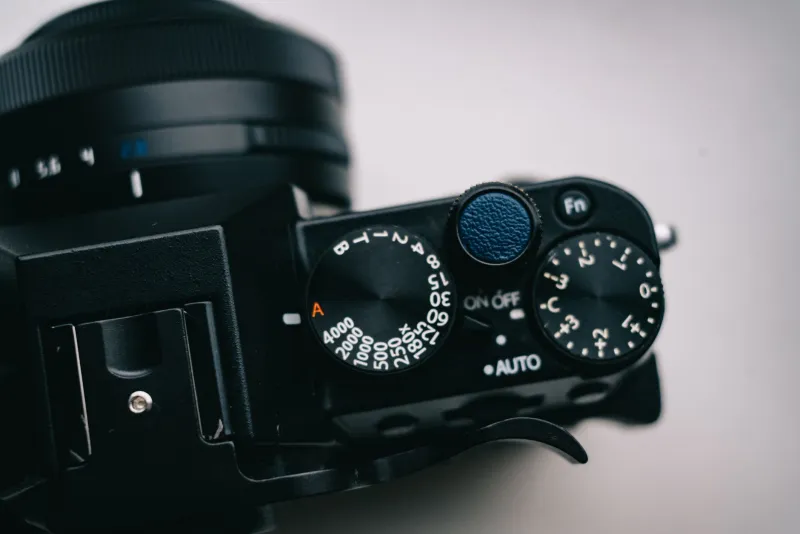
Your Fast Lens Isn't as Fast as You Think: The APS-C Aperture Truth Every X-T100 Shooter Needs to Know

You saved up, did the research, and finally dropped some real money on a fast prime. The lens barrel proudly reads f/1.8 or f/2. You slap it on your X-T100, shoot wide open, and wonder why the background separation doesn't quite look like what you've been seeing from full-frame photographers on YouTube. Something feels off.
Here's the thing: you're not imagining it. Your lens is technically telling the truth — but it's not telling the whole truth. And once you understand what's actually going on with aperture and sensor size, you'll approach your X-T100 kit with a completely different mindset.
What the Aperture Number Actually Measures
The f-stop number on your lens is a ratio — specifically, it's the focal length divided by the diameter of the entrance pupil (the effective opening that lets light through). A 50mm lens at f/2 has a 25mm entrance pupil diameter. That math doesn't change based on what camera body you attach it to.
So in terms of light transmission — how much light hits your sensor per unit area — a 50mm f/2 lens on your X-T100 behaves identically to a 50mm f/2 lens on a full-frame Sony or Canon. Your exposure settings, your ISO, your shutter speed — all of that stays the same. The aperture number isn't lying about light.
Where things get interesting — and where a lot of photographers get confused — is depth of field.
The Crop Factor Depth of Field Problem
The X-T100 uses an APS-C sensor with a crop factor of approximately 1.53x. That means the sensor is physically smaller than a 35mm full-frame sensor. To get the same field of view as a full-frame camera, you need to use a shorter focal length lens.
Here's why that matters for depth of field: shorter focal lengths produce more depth of field at any given aperture. So when you're using a 35mm lens on your X-T100 to get a field of view equivalent to a 53mm full-frame lens, you're actually shooting with a lens that has the depth-of-field characteristics of a 35mm lens — not a 53mm lens.
The practical upshot? To match the background blur of a full-frame photographer shooting a 50mm at f/1.8, you'd need to shoot with your X-T100 at roughly f/1.2 with an equivalent focal length. That's a lens that either doesn't exist for this system or costs a fortune.
Let's put some real numbers to this. Say a full-frame shooter is using a 85mm f/1.4 portrait lens. On your X-T100, the equivalent field of view comes from a 56mm lens. But to match both the framing and the depth of field, you'd need that 56mm lens to shoot at roughly f/0.9. Good luck finding that at a reasonable price.
The Effective Aperture Formula You Can Bookmark
Here's the simple math to convert full-frame aperture equivalents for your X-T100:
Equivalent f-stop = Stated f-stop × Crop Factor (1.53)
So:
- Your 35mm f/2 lens = roughly equivalent to a 53mm f/3.1 on full-frame (for depth of field purposes)
- Your 56mm f/1.2 lens = roughly equivalent to an 86mm f/1.8 on full-frame
- Your 23mm f/2 lens = roughly equivalent to a 35mm f/3.1 on full-frame
To run the calculation in reverse — finding what aperture you need on your X-T100 to match a full-frame lens:
Required APS-C f-stop = Desired full-frame f-stop ÷ 1.53
Want the look of a full-frame 85mm f/2 portrait shot? You need a 56mm lens shooting at about f/1.3 on your X-T100. The Fujifilm XF 56mm f/1.2 gets you almost there, which is exactly why that lens has such a devoted following among Fuji shooters.
Does This Mean Your X-T100 Can't Shoot Portraits?
Absolutely not — and this is where the conversation needs to be reframed. The comparison to full-frame is useful for understanding the physics, but it can become a trap if you let it make you feel like your camera is somehow inadequate.
The X-T100 produces genuinely beautiful subject separation at wide apertures. The Fujifilm XC 35mm f/2 is an affordable lens that gives you lovely background blur for portraits and everyday shooting. The XF 50mm f/2 is another compact option that punches well above its price point in this regard. You're not going to get the buttery-soft bokeh of a $2,500 full-frame 85mm f/1.4 combo, but you will get images that look polished, professional, and visually pleasing.
The key is calibrating your expectations based on what your system actually delivers — not what a different system delivers with different physics.
Real-World Test: Shooting the Same Scene
I ran a simple comparison shooting a coffee cup about three feet away, with a cluttered kitchen shelf roughly five feet behind it. I shot the same composition at f/2, f/2.8, and f/4 using a 35mm lens on the X-T100.
At f/2, the background shelf was pleasantly blurred — not invisible, but clearly secondary to the subject. Text on boxes was unreadable. At f/2.8, the blur softened slightly but remained strong. At f/4, I started to see more definition in the background elements.
The takeaway: even without full-frame physics on your side, shooting wide open on a fast prime with your X-T100 still creates a meaningful separation between subject and background. It just requires being intentional — getting closer to your subject, choosing backgrounds that are further away, and picking lenses that are genuinely fast (f/2 or faster).
Rethinking How You Buy Lenses for the X-T100
This effective aperture reality has a real impact on how you should evaluate lenses for your kit. A few practical guidelines:
Don't settle for f/2.8 zooms if background blur matters to you. On full-frame, f/2.8 is a workable portrait aperture. On your X-T100, it's closer to the depth-of-field equivalent of f/4.3 on full-frame. That's a landscape aperture. If you want subject separation, prioritize f/2 or faster primes.
The XF 56mm f/1.2 is worth the investment if you shoot portraits. It's the closest thing the X-T100 system has to a full-frame 85mm f/1.8 look, and it delivers.
Understand what you're actually buying when you go third-party. Some third-party lenses marketed as "fast" for Fuji mount come in at f/1.7 or f/1.8. That's still only equivalent to about f/2.6–f/2.8 in full-frame depth-of-field terms. Not bad, but not dramatic.
Use the crop factor to your advantage. The X-T100's sensor size means longer effective focal lengths from shorter physical lenses. That 50mm f/2 is acting like a short portrait lens on your body. Lean into it.
The Bottom Line
Your f/2 lens isn't lying to you about light — your exposures will be accurate and consistent. But it is giving you a different depth-of-field story than a full-frame photographer shooting the same f-stop. That gap is real, and it's worth understanding rather than ignoring.
The good news is that once you internalize the effective aperture math, you stop chasing the wrong benchmarks and start shooting smarter with the gear you've got. The X-T100 is a capable, genuinely fun camera. Work with its physics instead of against them, and the results will speak for themselves.