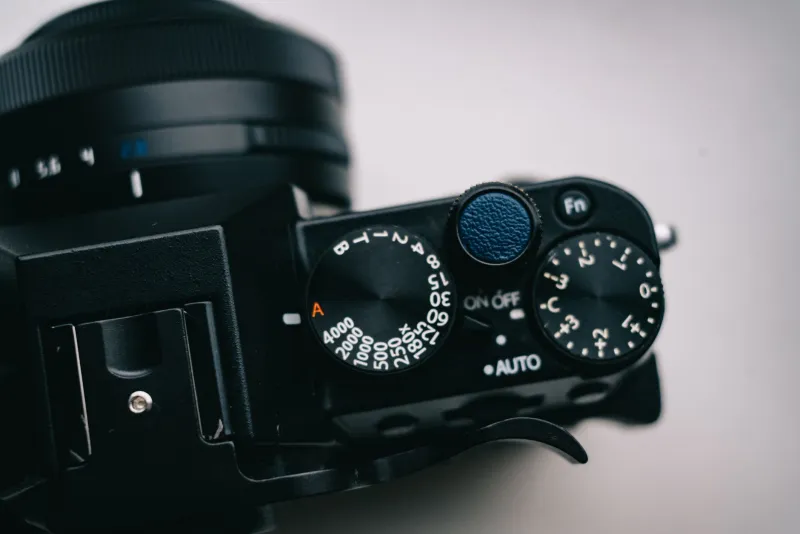
The EVF Delay Nobody Talks About: How to Shoot Smarter on the X-T100

Let's be honest about something. If you've spent any real time shooting with the X-T100 in fast-moving situations—a Little League game, a street fair in Austin, your kid's birthday chaos—you've probably noticed that what you see through the electronic viewfinder isn't quite what's happening in front of you. There's a slight delay. A beat behind. And depending on what you're photographing, that fraction of a second can mean the difference between a frame you love and a frame you delete.
This is EVF lag, and it's one of those things that rarely shows up in spec sheets but absolutely shows up in your photos.
What's Actually Happening in That Viewfinder
Unlike an optical viewfinder—which is essentially just a window—an electronic viewfinder works by capturing a live video feed from the sensor, processing it, and then displaying it on a tiny screen inside the eyepiece. That chain of events takes time. On the X-T100, the EVF refresh rate and associated latency are modest by mirrorless standards. You're looking at a delay that most estimates put somewhere in the 50–100 millisecond range under normal shooting conditions.
Fifty milliseconds doesn't sound like much. But consider that a baseball leaves a pitcher's hand and travels sixty feet in under half a second. Or that a toddler can change direction completely in the time it takes you to blink. In those contexts, a tenth of a second is a legitimate obstacle.
The X-T100 wasn't designed to be a sports camera, and Fujifilm never claimed otherwise. But people shoot all kinds of things with it—because it's affordable, capable, and genuinely fun to use. So rather than pretend the lag doesn't exist, let's talk about how to actually deal with it.
Stop Chasing, Start Anticipating
The biggest shift you can make as an X-T100 shooter is moving away from a reactive mindset and toward an anticipatory one. When you're chasing action through the viewfinder and reacting to what you see, you're always working with stale information. The lag guarantees it.
Instead, think about where your subject is going to be. Watch the pattern. Read the situation. A skateboarder in a Denver skate park is going to hit that same trick off the same ramp. A dog chasing a ball at the beach follows a pretty predictable arc. A street performer in New Orleans reaches a peak moment every few minutes.
Once you start shooting with the next moment in mind rather than the current one, the EVF lag becomes almost irrelevant. You're not reacting to the display—you're placing the camera where the action is about to land.
Zone Focusing: The Old-School Fix That Still Works
Here's a technique that street photographers have used since the film era, and it translates beautifully to the X-T100. Instead of relying on autofocus to lock onto a moving subject in real time, you pre-focus to a specific distance and shoot everything that falls within that zone.
On the X-T100, you can do this by switching to manual focus, setting your distance to something like eight to ten feet, stopping down to f/8 or f/11 for a deeper depth of field, and then shooting freely. With enough light and the right aperture, everything from roughly six to fifteen feet will be acceptably sharp—and you never have to wait for AF to confirm or worry about the EVF showing you something that already happened.
This works especially well with the 27mm pancake lens, which is compact enough to shoot from the hip without drawing attention. Set your zone, raise the camera, and fire when the moment feels right. It sounds low-tech, but the results can be genuinely excellent.
Using the LCD as an Alternative
One underrated workaround for EVF lag is simply flipping out the X-T100's tilting touchscreen and using it instead of the viewfinder. The rear LCD doesn't eliminate the processing delay entirely, but it does allow you to shoot from a wider range of positions—low to the ground, overhead, around corners—that naturally lend themselves to a more patient, compositional approach.
When you're not locked to the eyepiece, you also tend to stay more spatially aware of your environment. You see more of what's happening around your frame. That awareness helps you anticipate better, which loops back to the core strategy: stop chasing, start reading.
Pre-Focus and Half-Press Discipline
Another practical technique involves disciplined use of the half-press shutter. If you're photographing something with a predictable path—a runner on a track, a car coming through an intersection, a bird on a fence that's about to take flight—find the spot where they'll be, half-press to lock focus there, and wait. When the subject arrives in that zone, full press.
You're essentially removing the AF acquisition step from the moment of capture. The camera doesn't have to hunt, confirm, or adjust. You've already done that work. And because you're not staring at a moving target through the EVF, you're not being misled by lag either.
This takes practice. Your instinct will be to keep re-acquiring focus as the subject moves. Resist it. Trust the pre-focus point, and you'll be surprised how often you nail the timing.
Adjusting Your Shutter Speed Expectations
One more thing worth mentioning: EVF lag can cause you to underestimate how fast you need your shutter speed to be. Because the display is showing you a slightly smoothed, slightly delayed version of reality, motion can look more manageable than it actually is. You frame what looks like a clean shot, fire, and end up with motion blur.
As a general rule, shoot faster than you think you need to when the subject is moving. If 1/500 feels right based on what you see, try 1/800 or 1/1000. The X-T100 has plenty of resolution to work with, and you can afford to be conservative with shutter speed without sacrificing much.
Reframing the Limitation
Here's the thing about EVF lag on the X-T100: it's real, it matters in specific situations, and it absolutely costs you shots if you don't account for it. But it also nudges you toward a more considered shooting style. When you can't rely on pure reaction speed, you start investing more in reading scenes, understanding light, and positioning yourself better.
Some of the most compelling photographs ever made were taken with cameras that were technically slower and less capable than the X-T100. The photographers behind those images succeeded because they understood their tools deeply enough to work within their limits.
The EVF lag isn't going away. But with the right techniques, it stops being a silent killer—and starts being a quiet teacher.